WACV 2026

FUME: Fused Unified Multi-Gas Emission Network

Dual-stream segmentation for thermal CO₂ and CH₄ plumes, purpose-built to flag rumen acidosis early without invasive sensors.

Taminul Islam, Toqi Tahamid Sarker, Mohamed Embaby, Khaled R Ahmed, Amer AbuGhazaleh

Southern Illinois University Carbondale

FUME Efficiency Trade-off

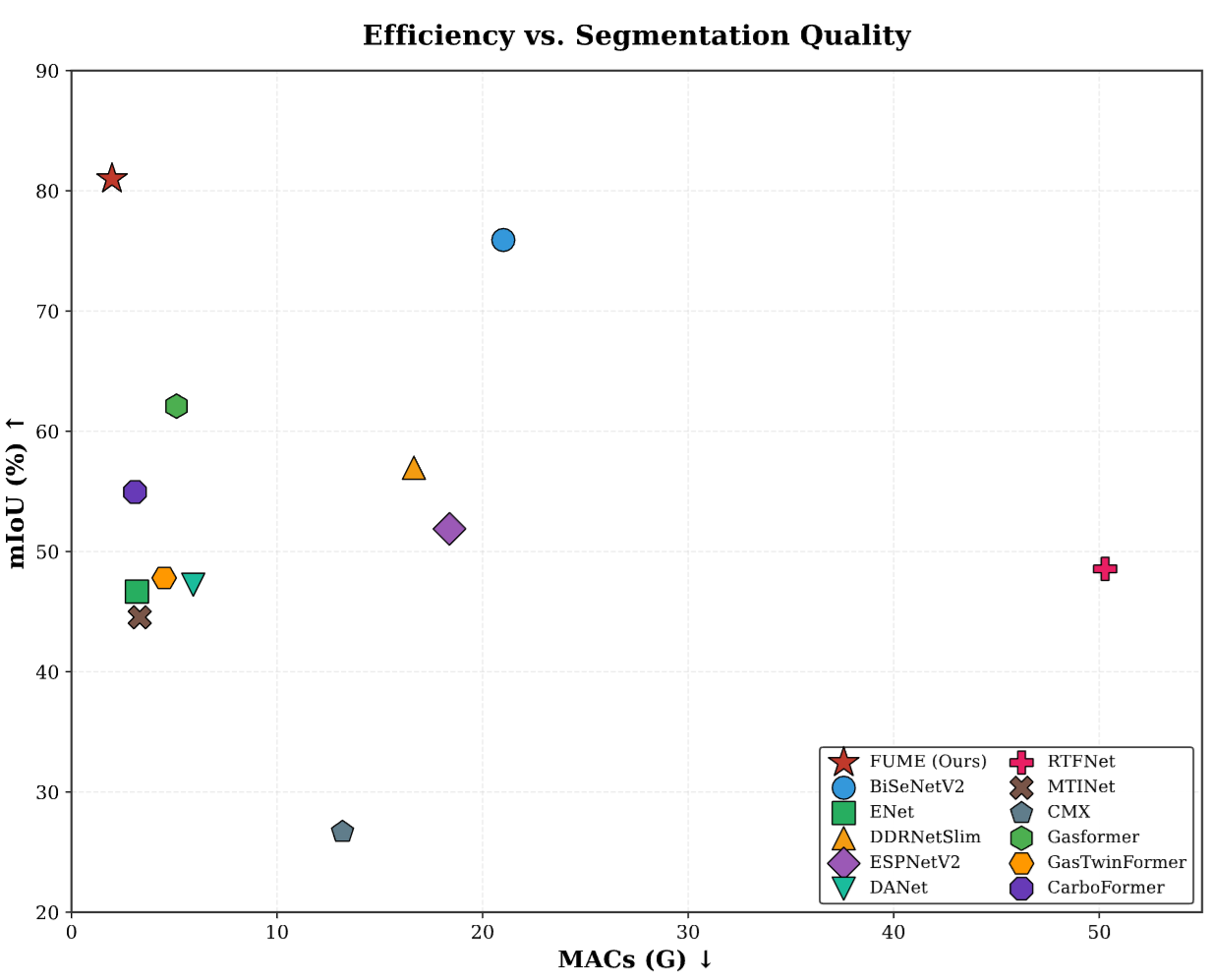
FUME achieves optimal efficiency-quality trade-off, positioned in the upper-left region with high mIoU and low computational cost.

93.2%
Dice Score
87.8%
Mean IoU
0.47M
Parameters
12ms
Latency

Why FUME Matters

Early, non-invasive rumen health checks through precise multi-gas plume segmentation

Rumen acidosis quietly erodes animal welfare and production. Farmers need a rapid, hands-off indicator rather than invasive probes or lab work. FUME reads thermal CO₂ and CH₄ plumes directly to surface early warning signals.

The network aligns paired modalities through a weight-shared FastSCNN encoder, modality-specific self-attention, and channel-attention fusion, producing unified segmentation masks tailored to gas behavior.

With only 0.47M parameters and 12ms latency, FUME runs on edge devices while delivering 93.2% Dice and 87.8% mIoU, outperforming Gasformer, GasTwinFormer, and CarboFormer in both accuracy and efficiency.

Key Contributions

Novel components enabling efficient multi-gas emission analysis

Lightweight & Fast
Only 0.47M parameters with 12ms inference latency, enabling real-time deployment on edge devices for practical farm applications.
State-of-the-Art Results
Achieves 93.2% Dice and 87.8% mIoU, outperforming all existing OGI-specific and general segmentation methods.
Dual-Modal Fusion
Novel channel attention fusion mechanism effectively combines CO₂ and CH₄ thermal streams for comprehensive analysis.

Method

A unified architecture for multi-gas emission segmentation and health classification
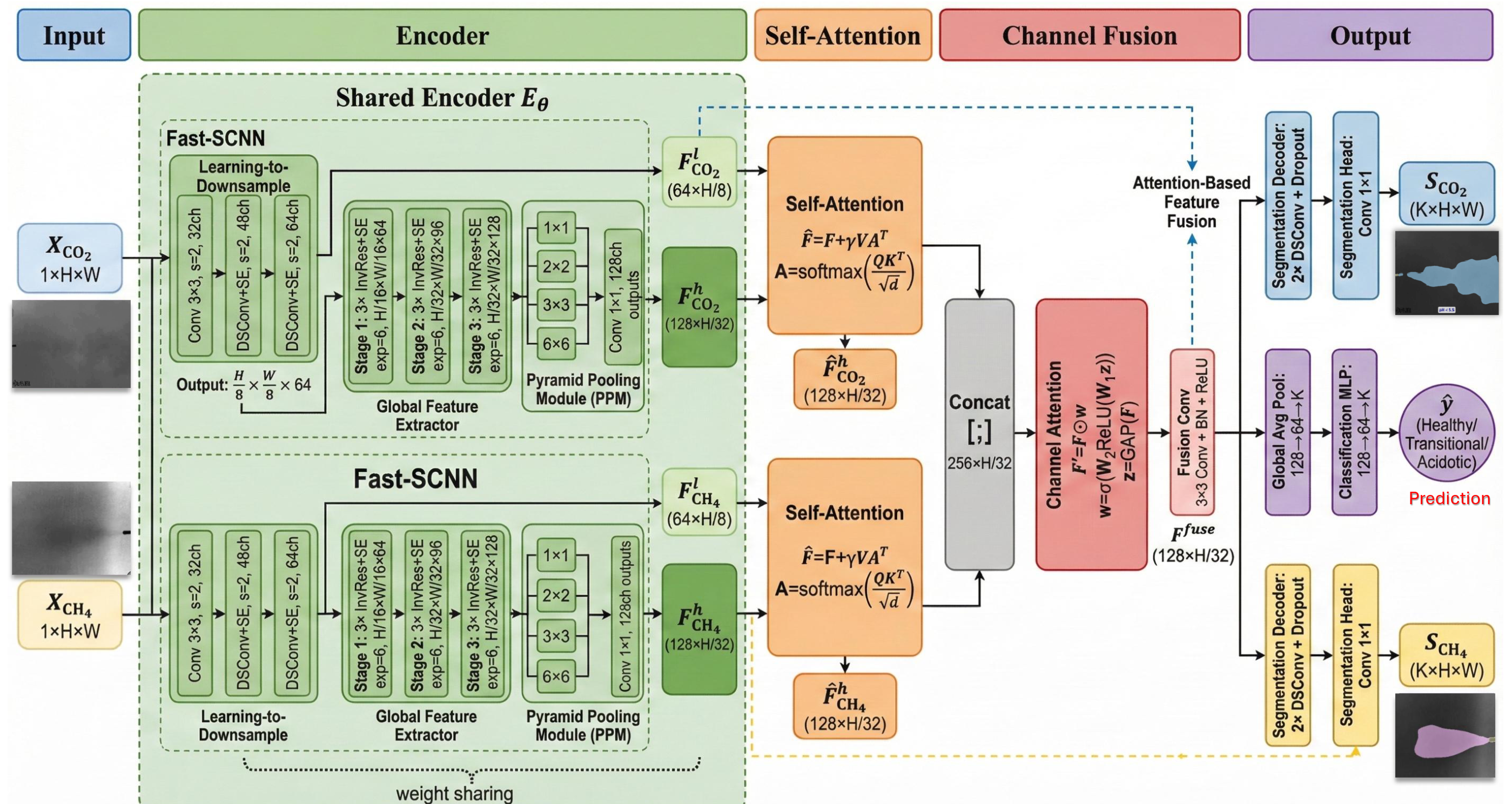
FUME Architecture
1 Learning-to-Downsample
Efficient spatial reduction module that reduces input resolution to H/8 × W/8 using depthwise separable convolutions for minimal computational overhead.
2 Global Feature Extractor
Pyramid Pooling Module captures multi-scale contextual information at H/32 × W/32 resolution for comprehensive scene understanding.
3 Modality Self-Attention
Dedicated self-attention modules for each gas stream (CO₂ and CH₄) enable modality-specific feature refinement before fusion.
4 Channel Attention Fusion
Attention-based combination of dual streams produces unified representations for downstream segmentation and classification tasks.

Results

Comprehensive evaluation against state-of-the-art methods
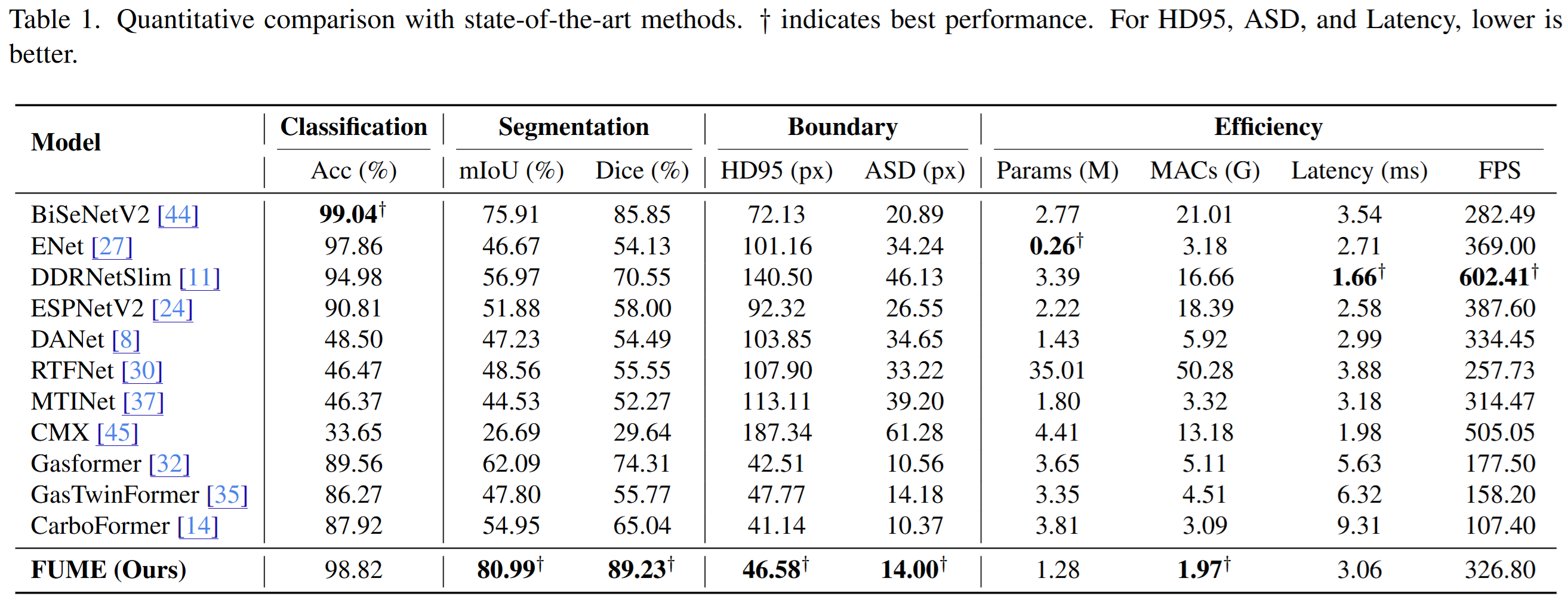
Quantitative Comparison
Quantitative Comparison with State-of-the-Art
Comprehensive performance comparison across segmentation metrics (Dice, IoU, HD95, ASD) and efficiency measures. † indicates best performance. For HD95, ASD, and Latency, lower is better.
SOTA Comparison
Performance Analysis
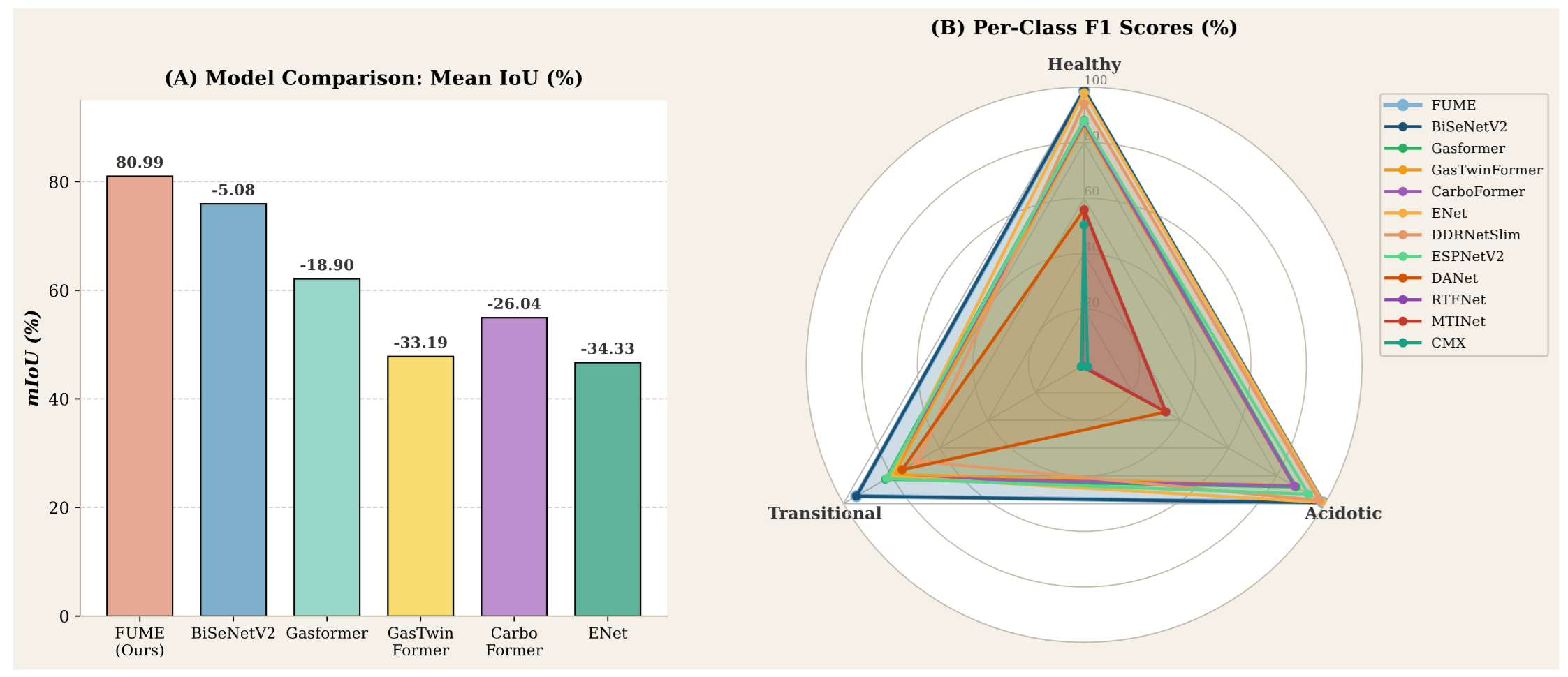
(A) Mean IoU comparison showing FUME substantially outperforms both general segmentation baselines and OGI-specific methods (Gasformer, GasTwinFormer, CarboFormer). (B) Per-class F1 radar chart demonstrating balanced classification performance across Healthy, Transitional, and Acidotic classes.

Result Comparison Spotlight

The qualitative panel below is the key evidence: FUME cleanly segments CO₂ and CH₄ plumes across Acidotic, Transitional, and Healthy cases. Note the tight boundaries, modality-consistent masks, and correct health tags even under faint, elongated, or fragmented gas shapes—critical for trustable early acidosis alerts.
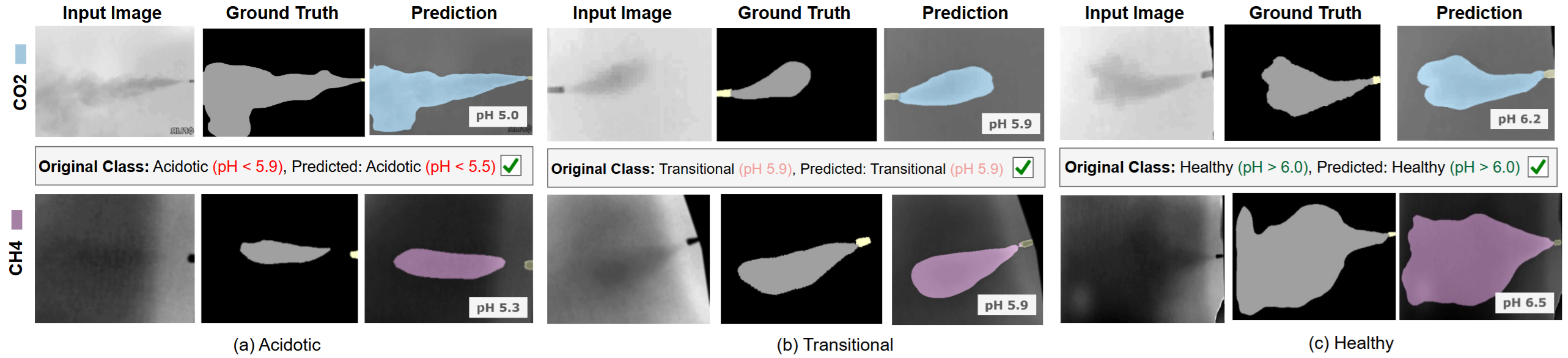
Qualitative Results
Qualitative Segmentation Results
Visual comparison across Acidotic, Transitional, and Healthy classes for both CO₂ and CH₄ modalities. FUME achieves precise boundary delineation of gas plumes with predictions closely matching ground truth annotations, demonstrating robustness to varying plume morphologies.
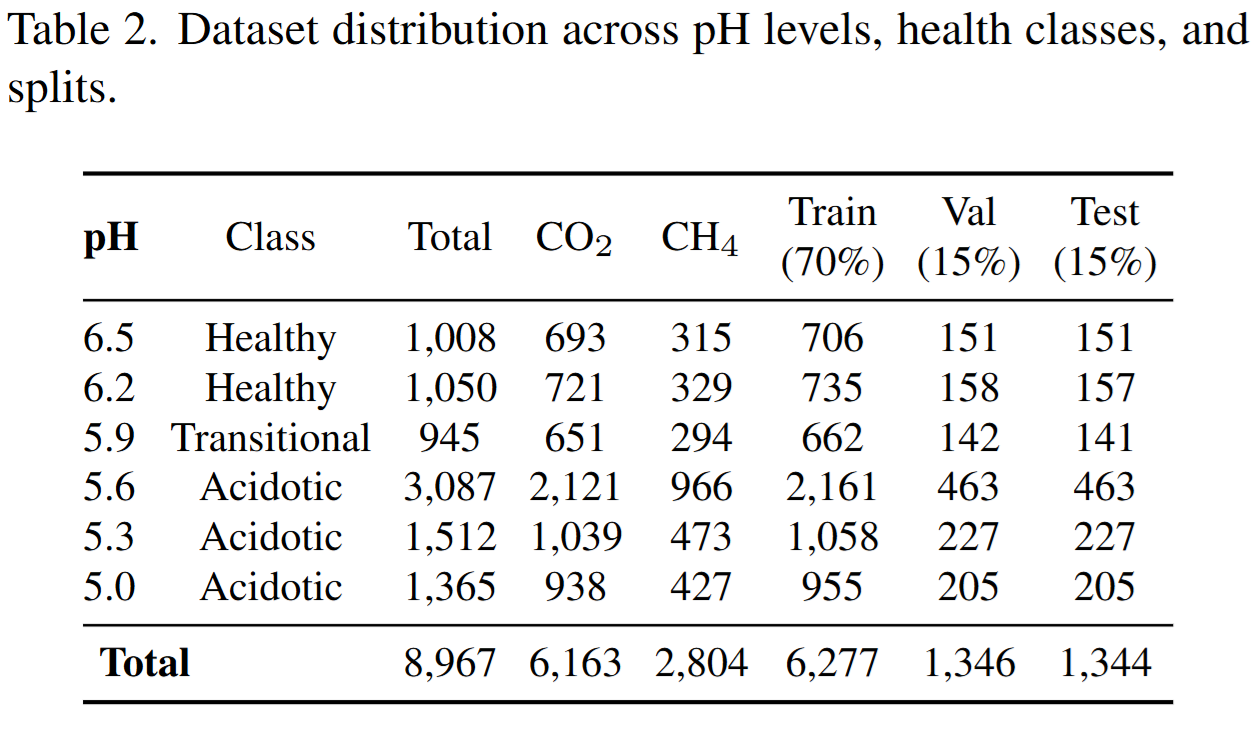
Dataset Distribution
Dataset Statistics
Distribution across pH levels, health classes, and train/validation/test splits.
Per-class F1 Scores
Classification Performance
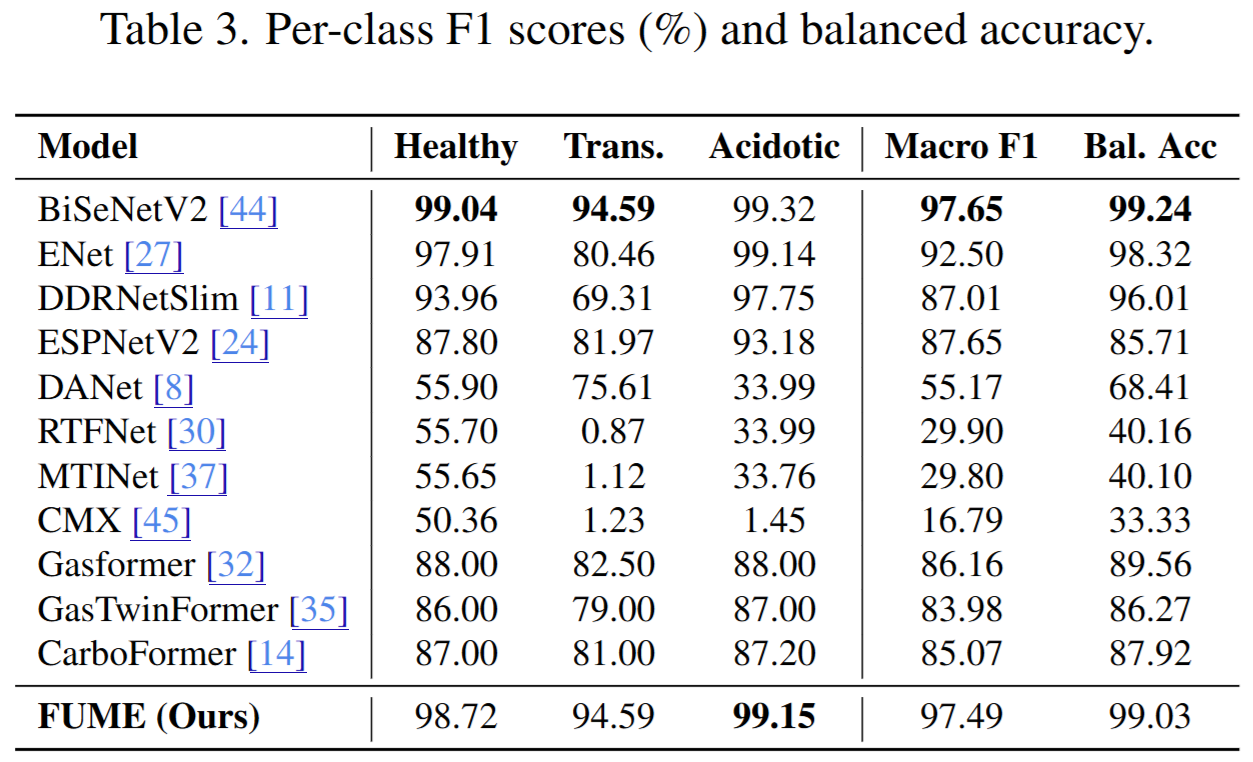
Per-class F1 scores (%) and balanced accuracy metrics across all health classes.

Ablation Study

Understanding the contribution of each architectural component
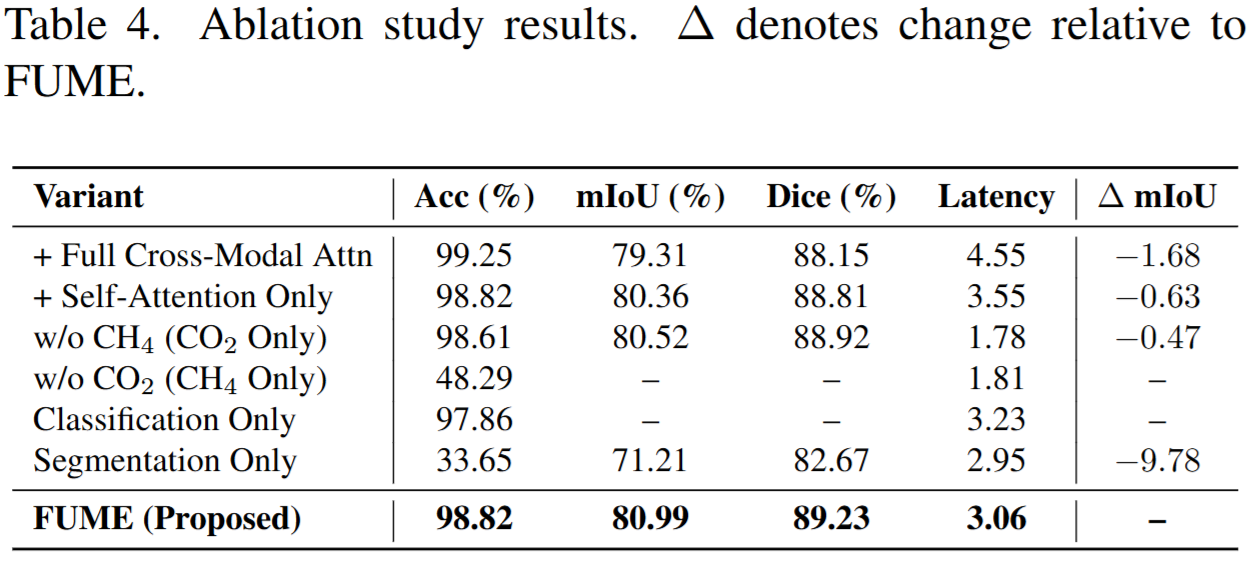
Ablation Table
Component Analysis
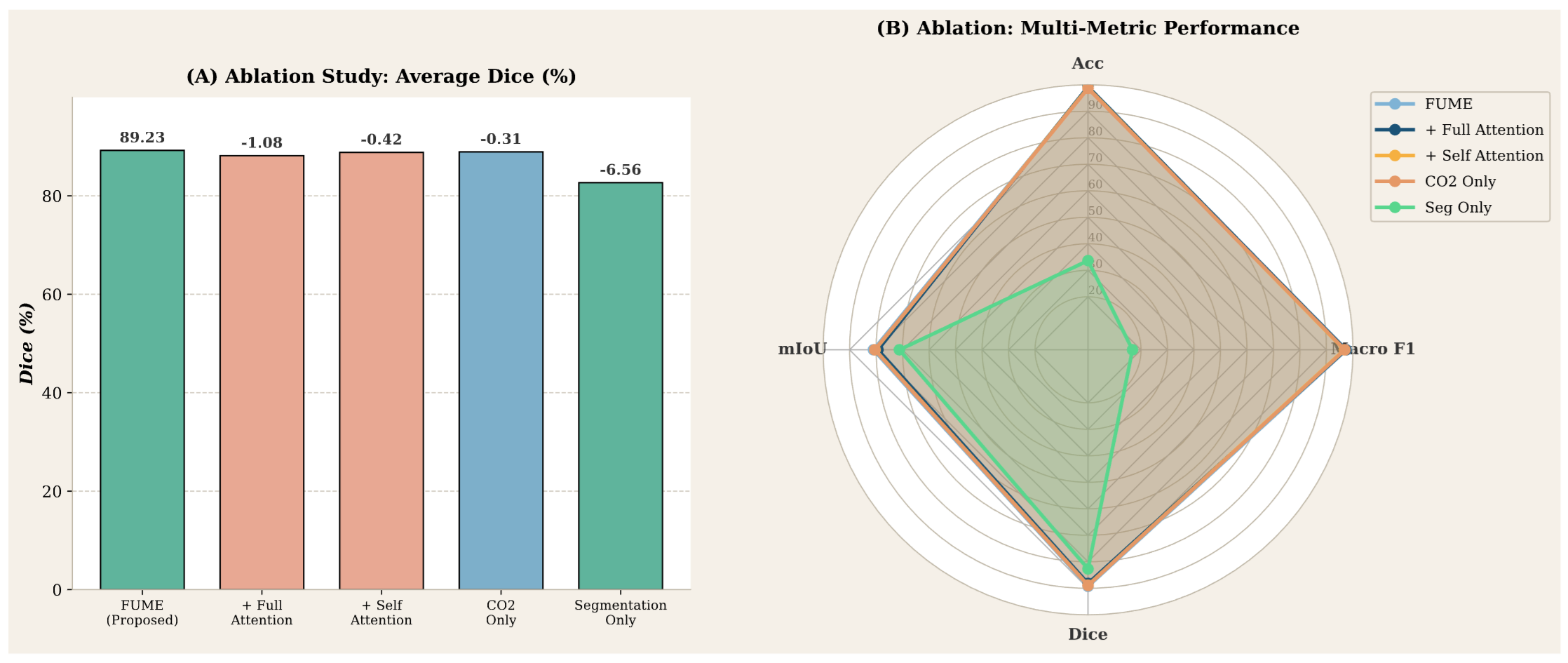
Quantitative ablation showing the impact of removing each module. Δ denotes change relative to the full FUME configuration.
Ablation Visualization
Visual Ablation Analysis
(A) Dice coefficient comparison across architectural variants. (B) Multi-metric radar chart highlighting the critical importance of CO₂ modality and dual-task learning.

Citation

If you find our work useful in your research, please consider citing

@misc{islam2026fumefusedunifiedmultigas,
    title={FUME: Fused Unified Multi-Gas Emission Network
           for Livestock Rumen Acidosis Detection},
    author={Taminul Islam and Toqi Tahamid Sarker and
            Mohamed Embaby and Khaled R Ahmed and
            Amer AbuGhazaleh},
    year={2026},
    eprint={2601.08205},
    archivePrefix={arXiv},
    primaryClass={cs.CV},
    url={https://arxiv.org/abs/2601.08205},
}